🧠 What Your Keyboard Can Teach Us About Design & Digital Behavior
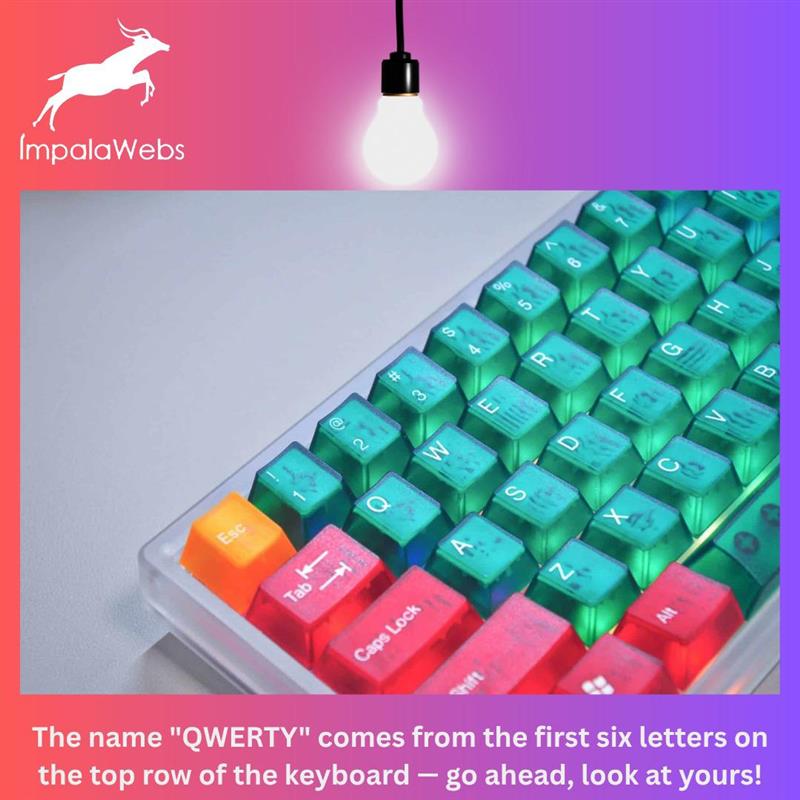
The ultimate time you saw your keyboard, whilst did you notice your keyboard, whilst? Looking at the primary row of the letters, you may see what you've already guessed: Q-W-E-R-T-Y.
There is a purpose behind that set-up. It is a design choice that was taken more than 150 years ago, and that continues to influence our relationship with technology today.
We do not simply create websites and applications at Impala Webs Pvt. Ltd., we research human behavior, design psychology, and also the inner workings of legacy systems and interaction with users. And QWERTY is the ideal example of how history is important in the digital world.
We shall delve into the way this vintage keyboard layout became the global standard- and what it is to contemporary product designers, UI/UX professionals, and digital strategists.
📜 The Origins of QWERTY: A Machine-to-Machine Problem
The narration starts in the 1870s when Christopher Latham Sholes invented the typewriter. His initial design of keyboards was in an alphabetical arrangement.
But there was one big issue, which was that fast-typing typists congested the machine.
Where users typed popular letter combinations too fast (such as TH or ER), there was a collision between the metal typebars within the machine, and the type bars became stuck together.
The solution? Slow them down.
Sholes reconfigured the keys in a manner that was able to separate the letters that were most used. This decreased mechanical jamming and enhanced performance at the expense of typing speed.
That arrangement? QWERTY - the name derived from the first six letters on the top row.
1) QWERTY Becomes the Standard
In 1873, Remington and Sons used the QWERTY layout when they commercialised their typewriters. This choice would determine the design of keyboards in the following century.
Once the computers were introduced in the 20 th century, the manufacturers took the same layout familiar to everyone, not because it was the best, but because it was what the users were used to.
Flash forward to the present: the QWERTY layout is found in more than 90 percent of the gadgets of the world, smartphones, smart televisions, ATMs, point of sale machines, and, naturally, laptops and desktops.
2) Designed for Jams, Not Speed
It is important to note that the QWERTY keyboard had never been created with maximum efficiency and comfort in mind. It was intended to minimize the mechanical failure- an issue that is no longer there.
So why haven’t we updated it?
Because habits are powerful.
When it has become a world standard, altering it even to a better one needs a struggle:
- Deep-rooted muscle memory
- Current software & hardware compatibility
- User and institutional resistance
3) Substitutes (However, Not Adopted)
Several keyboard layouts are faster and more ergonomic than QWERTY:
- Dvorak Simplified Keyboard: This was created to decrease finger movement.
- Colemak Layout: A compromise of speed and simplicity of studying.
These designs are technically higher, even though they have loved a minor adoption because of the sheer dominance of QWERTY.
4) The Lessons of Design and UX QWERTY Teaches
This is why this is important to leaders, product designers, and digital strategists:
Even flawed legacy design decisions may belong-livedd.
Learning this principle can unite your team:
- Rule out respect for user habits and cognitive patterns.
- Create interfaces that are easy to use and user-friendly.
- Establish platforms that reduce friction rather than create disruption.
In Impala Webs Pvt. Ltd., we always enquire:
- How does a user think?
- What have they already been trained to do?
- How shall we plan to their reality, not to our own?
QWERTY is a lesson in empathetic building, not innovative building.
Big Picture, Small Choices, Massive Impact
Think about it:
- The design modification that happened in the 1870s, however, continues to affect the typing of billions of people in 2025.
- The user experience is not just about the path creation, but it is also about the comprehension of the old paths.
Whether it is a digital product, a redesign of a web platform, or streamlining a mobile interface, the QWERTY lesson applies:
The decision that is made by designers reverberates. Make them wisely.
🔍 Final Thoughts
The QWERTY association is not just an ancient accident, but additionally a look inside the intersection of technology, behavior, and design.
As enterprise leaders, CTOs, and designers, we should recollect more than appears and pose the question:
What influence today is the building that we shape by habit, past, and man?
Whereas at Impala Webs Pvt. Ltd., we code websites, we create experiences based on real-life behavior, the historical approach, and digital intelligence.
Need to create spaces people enjoy spending time in?
Let’s connect. In either case, as a startup founder or a corporate decision-maker, we will assist you to design thoughtfully, persuasively, and purposefully.
📧 Reach us at: Contact Info
🌐 Visit: Website